
Car electrical issues are expensive to diagnose because a single weak power or ground connection can trigger warnings in multiple modules. A seller may describe the problem as “just a battery,” while the actual cause could be an intermittent charging fault, water intrusion, network communication failure, or a control module that never enters sleep mode.
A used-car buyer does not need to perform workshop-level auto electrical troubleshooting. The buyer needs a repeatable test sequence, preserved diagnostic evidence, and a technician who can measure the circuit under the conditions that reproduce the symptom.
Start by defining the symptom precisely.
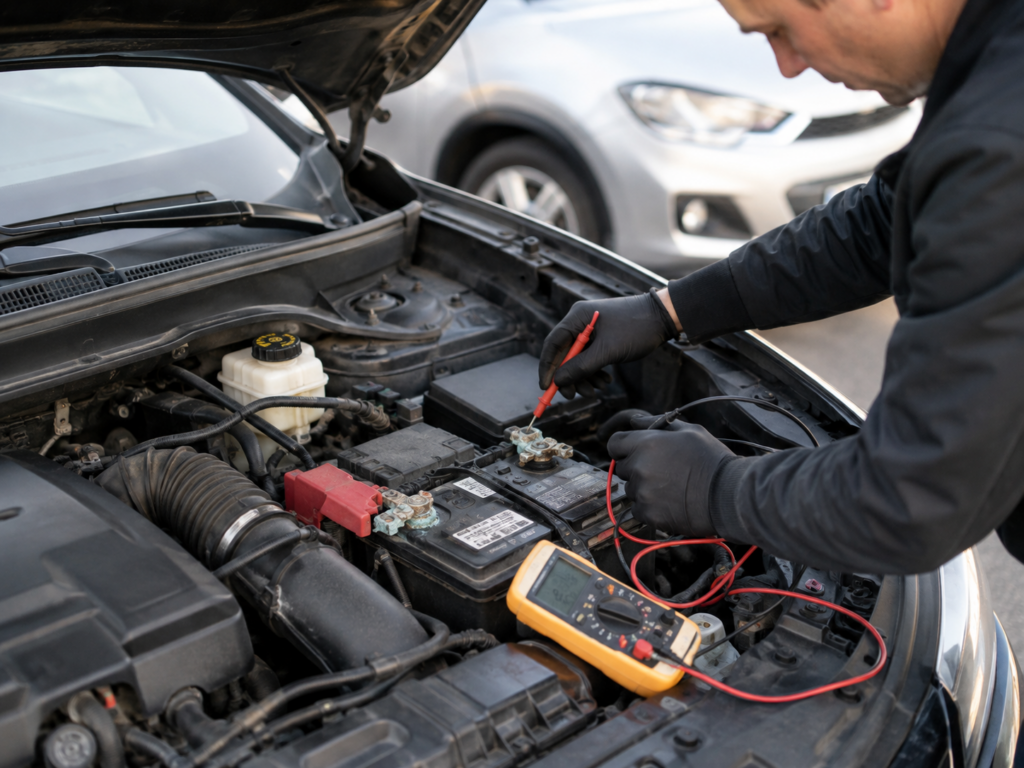
“Electrical problem” is not a diagnosis. Record what happened and the vehicle’s state at the time:
- Did the engine crank slowly, click once, crank normally without starting, or show no response?
- Did warning lights appear before or after the engine started?
- Did the problem occur cold, hot, after rain, after charging a device, or after sitting overnight?
- Did one feature fail, or did unrelated systems reset together?
- Did the clock, radio presets, or window initialization reset, suggesting a low-voltage interruption?
- Did the vehicle recover after a boost, and did the symptom return after driving?
This description separates a starting complaint from a power-supply collapse, network fault, or individual accessory circuit.
A buyer-safe electrical test sequence
1. Inspect before powering the car
Look for loose or improvised battery terminals, corrosion, melted fuse-box plastic, non-factory wire taps, damaged grounds, moisture, missing covers, and recently cleaned areas beside dirty surroundings. Confirm that the battery type and rating match the vehicle’s requirements, especially where battery registration or an absorbed-glass-mat battery is specified.
Do not disconnect the battery to “reset everything.” That can erase evidence, wake modules, require relearning, and create new symptoms.
2. Observe wake-up, start, and loaded operation
Operate the vehicle from locked and asleep through unlock, accessory mode, start, or READY mode, loaded idle, test drive, hot restart, and shutdown. Use headlights, rear defrost, blower, seat heaters, windows, locks, wipers, cameras, and charging ports. Watch for flicker, slow motors, warning messages, resets, or a symptom that appears only when the electrical load rises.
3. Scan every available module before clearing codes
An engine-only code reader can miss body, chassis, restraint, gateway, and infotainment faults. Ask for a full-vehicle scan showing current, pending, history, and communication codes, plus freeze-frame or event data where available. Many U-codes can be secondary to a low-voltage event; the time, status, and module pattern determine whether they are active evidence or old noise.
Acar’sr issues record search can add reported problem context, but it cannot read live modules or measure a circuit. Keep the report and scan as separate evidence layers.
Battery state of charge is not battery state of health

A 12-volt battery can be discharged yet recover after proper charging, or it can show normal open-circuit voltage and still collapse under load. Temperature, battery chemistry, and surface charge affect voltage interpretation.
A technician should first verify the state of charge, then use the manufacturer-approved conductance, load, or diagnostic procedure to assess the state of health. Record measured voltage, test method, battery rating entered into the tester, temperature where relevant, and the printed result. A handheld tester set to the wrong battery standard can produce a persuasive but invalid answer.
Repeated boost starts are a symptom, not a battery diagnosis. The cause may be an aged battery, charging fault, parasitic draw, poor terminal, ground resistance, short trips, software wake-up or an accessory left active.
Charging-system voltage is not one universal number
Older systems often regulate around a relatively narrow voltage range, while smart alternators and battery-management systems deliberately change output with temperature, load, battery state and deceleration strategy. A single reading at warm idle cannot prove or disprove a car alternator issue.
For car battery charging issues, ask the technician to follow the OEM procedure and record:
| Test condition | Evidence to capture | Why it matters |
|---|---|---|
| Engine off after stabilization | Battery voltage and state of charge | Establishes whether testing begins with a charged battery |
| Cranking | Minimum voltage and current behaviour with correct equipment | Reveals supply collapse, connection resistance or starter demand |
| Idle and raised speed | Commanded and actual charging information where supported | Smart charging may intentionally vary output |
| Electrical load applied | Voltage, current and warning response | Faults can appear only when demand rises |
| Cable and ground under load | Voltage drop across each path | Finds resistance that an unloaded continuity test can miss |
Fluke’s automotive troubleshooting guide explains voltage-drop testing: measure across a connection while current flows. Generic limits can illustrate the method, but the manufacturer’s specification and circuit current control the pass/fail decision.
Do not pierce insulation, short alternator terminals or place a meter in a high-current path unless you are trained and using the correct fused equipment. Buyer-level evidence should come from a qualified technician.
Power windows not working: follow the circuit, not the switch price
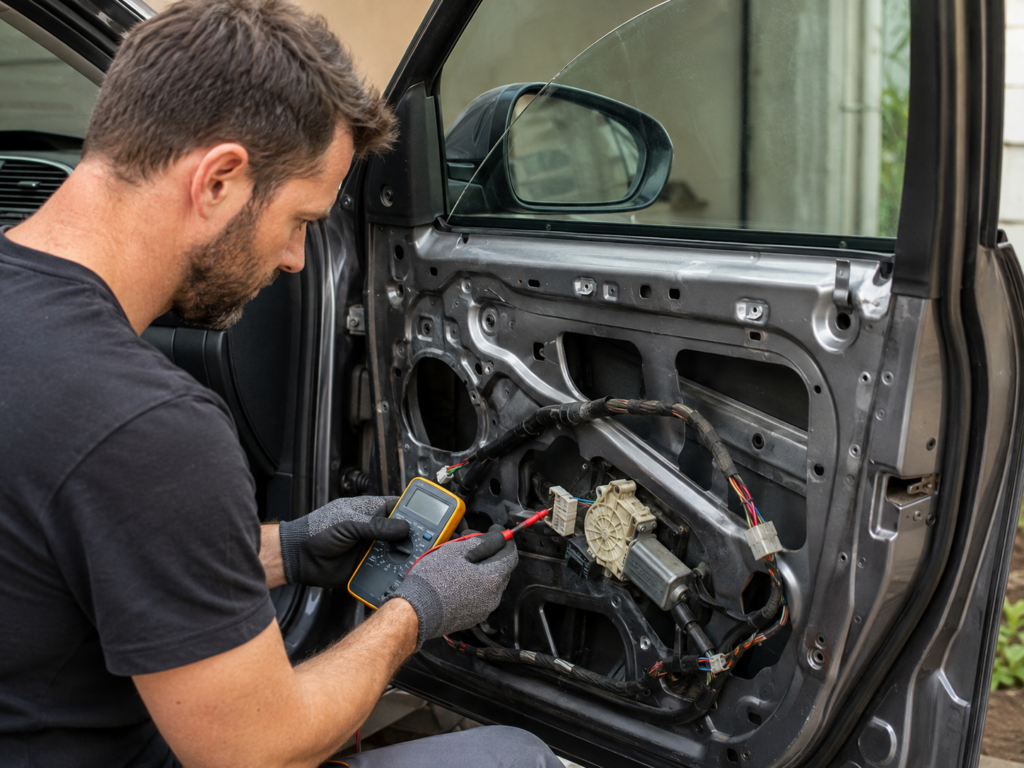
When power windows are not working, note whether one window, one door or every window is affected; whether the master and local switches behave differently; and whether the motor makes noise. Those observations narrow the circuit but do not identify the failed part by themselves.
To fix power windows correctly, a technician may need to verify:
- Fuse and circuit-breaker condition under load, not only by visual inspection.
- Scan data and bidirectional commands where a door module controls the motor.
- Power and ground at the motor while the switch is commanded.
- Voltage drop through wiring, connectors, switch contacts and the door-jamb harness.
- Motor current and mechanical regulator movement.
- Window initialization, anti-pinch calibration and software requirements after repair.
A clicking motor can indicate a jammed regulator or weak motor, while silence can come from a switch, module, broken wire, missing feed or failed motor. Replacing the switch because it is easy to reach is parts swapping, not diagnosis.
Parasitic draw requires the vehicle to be asleep
An overnight battery drain can come from a lamp, aftermarket tracker, audio equipment, stuck relay or a network module that repeatedly wakes the car. Measuring immediately after shutdown can be misleading because modules, pumps and telematics may remain active for a model-specific period.
Fluke’s parasitic-drain procedure explains that the vehicle may need substantial time to enter sleep mode. The correct acceptable draw and sleep time come from service information for the exact vehicle and installed equipment.
Ask for a report that identifies battery state of charge, meter or current-clamp method, elapsed sleep time, final stable draw, wake-up events and the fuse or circuit isolation result. Opening a door or communicating with some scan tools can wake modules and invalidate the reading.
Flooded-car electrical issues can appear later
Water can leave conductive residue and corrosion inside connectors, splices, modules, grounds, seat wiring and fuse boxes. A dried interior can operate during a short viewing and fail weeks later as corrosion progresses.
NHTSA’s flood-damaged vehicle guidance recommends checking for musty odour, dirt or water lines in unusual places and corrosion. Inspect beneath carpets and the spare-wheel well, under seats, behind lower trim and around low-mounted modules. Look for silt in connectors, green or white corrosion, mismatched upholstery and unexplained replacement modules.
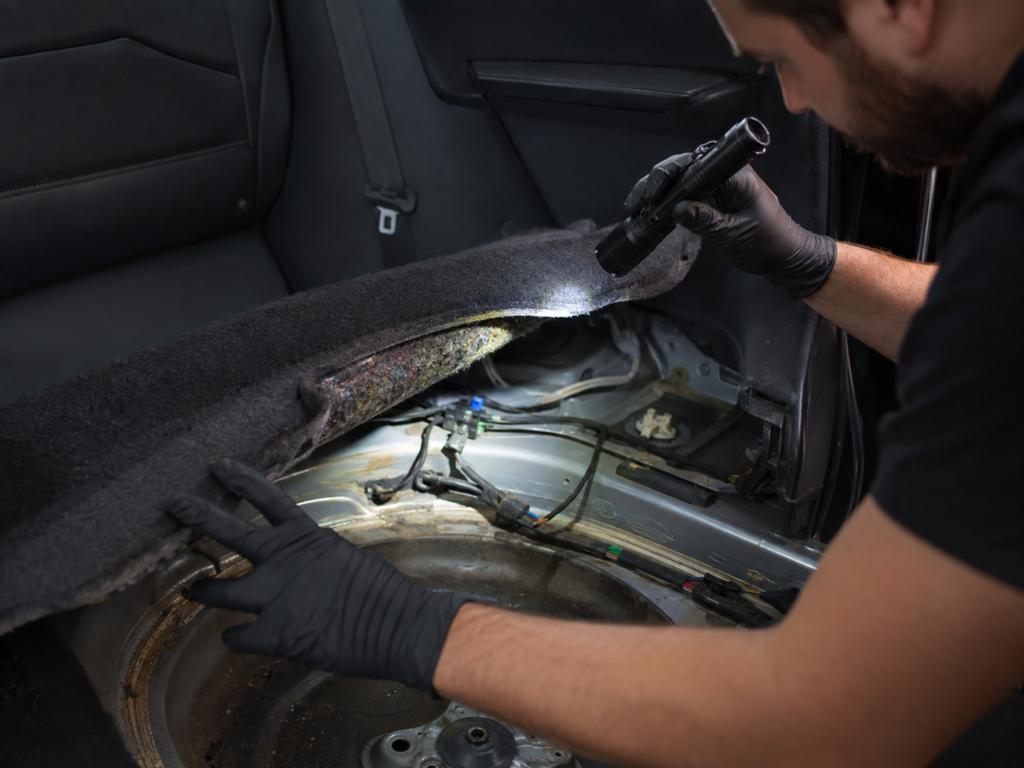
Use accident records and available registration or auction history to look for flood or salvage context, then commission a physical inspection. A clean history result cannot rule out unreported water exposure.
Recalls, service bulletins and model-specific complaints
Searches for electrical problems by brand or model are too broad to diagnose a vehicle. The same name can cover different generations, engines, wiring layouts and software. Use the full VIN and build date, then check a VIN-specific recall search and confirm open campaigns with Transport Canada.
A technical service bulletin can describe a known diagnostic path, but it is not automatically a recall, warranty extension or proof that the viewed car has the condition. Match the bulletin’s model year, production range, equipment and symptom, then verify the prescribed measurements.
Does car insurance cover electrical issues?
Coverage usually depends on the cause and the policy, not on the fact that wires or modules were damaged. Sudden insured events such as collision, theft or covered flooding may be treated differently from wear, corrosion, mechanical breakdown, poor repair or an aftermarket installation.
Ask the insurer in writing about the exact VIN, prior damage and intended coverage. Obtain a pre-purchase inspection and keep repair records. An online generalization cannot establish whether a future claim will be paid.
Decide from repeatable evidence
Proceed when the car starts cold and hot, loaded systems work consistently, the module scan has an explained pattern, battery and charging tests follow the correct procedure, and no water or wiring alteration remains unexplained. Renegotiate when a specific fault has a measured cause and written repair estimate. Walk away when intermittent resets cannot be reproduced or explained, the seller cleared codes, moisture reaches modules, safety-system warnings remain active, or wiring repairs are undocumented.
Diagnosing electrical problems in cars means connecting the symptom to an operating state, circuit measurement, and root cause. For a buyer, that discipline is more valuable than a list of components that might fail.